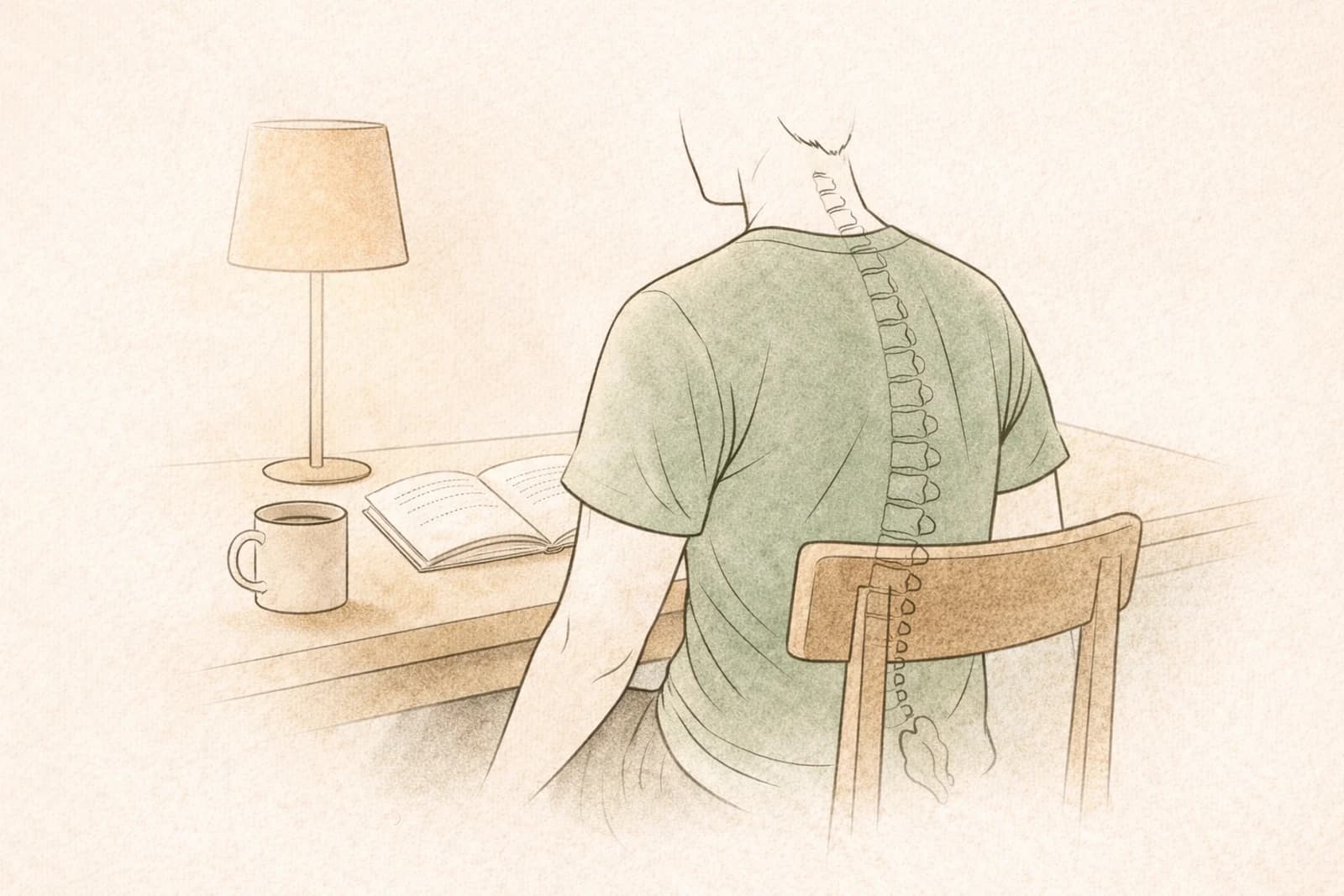
Posture, fixed in two minutes a day
Your back hurts because you sit all day. The research-backed reset for desk workers.
Fixing posture takes a brief daily routine plus one change to how you sit or stand. Research summarized by Harvard Health and the American Academy of Orthopaedic Surgeons shows that short movement breaks, targeted mobility drills, and a reasonable desk setup reduce rounded shoulders, neck strain, and lower-back pain. Posture correctors alone do not work. This hub covers two-minute resets, desk setup, back-pain exercises backed by NIAMS and JOSPT, and the routines that fit a work-from-home day.
Posture work is simple but specific. A two-minute mobility reset in the morning, a desk setup that puts your eyes at the top of the screen, and a few honest strength exercises for the muscles that hold you up. No braces. No gadgets. The guides below start with the pain, give you the fix, then explain the why. Citations pull from NIH NIAMS, AAOS, JOSPT, and OSHA computer-workstation guidance.
Join The Healthy Guide
Weekly 2-minute resets for desk workers and stiff backs.
Go deeper
Fix Rounded Shoulders in 5 Moves
The daily mobility drill that opens a closed chest without a posture corrector or a chiropractor.
The 2-Minute Desk Reset
Stand, mobilize, return. The routine that undoes six hours of sitting in under three minutes.
Lower-Back Pain Exercises: The 5 That Actually Help
What NIAMS and JOSPT recommend for non-specific low-back pain — ranked by evidence, not opinion.
Sciatica Stretches: What to Try First
Gentle stretches backed by systematic reviews. When to use them, and when to see someone.
Do Posture Correctors Actually Work?
The short answer is no. The long answer explains why the ones that feel like they help are the ones you need least.
Desk Setup for a Pain-Free Back
Monitor height, chair depth, keyboard distance. Three adjustments that fix most desk-worker pain.